
By Caitlin Wiley, Board Member
Editors: Jennifer Fleck, Board Chair and Talia Soorenko, Content Contributor
PDF of: December 2025: Celebrating the Season Without the Waste; WADING IN FOR SUSTAINABILITY Newsletter #3
| Thank you for reading! Sustainability Around the Holidays |
’Tis the season of giving, a time of year when many of us indulge, share moments with friends and family, and buy more. While we all spend our holidays differently, one thing is true across the United States: the holidays generate a lot of extra waste. Between Thanksgiving and New Year’s Day, Americans throw out an estimated 25% more than normal.¹ This spike comes from increased consumption tied to food, gift giving, single-use packaging, and decorations, including Christmas trees.
This problem of extra holiday waste isn’t limited to the U.S. – in the U.K., enough wrapping paper is thrown away each year at Christmas to reach the moon. That’s an astounding total of 228,000 miles of wasted paper.²
While these numbers are shocking, the holidays are also a beautiful time of year when people gather to connect with those who are most important to them. To maintain the happy spirit of the holidays without harming the planet, we can all make positive changes to reduce our impact on it. This edition of our monthly newsletter will focus on how to celebrate the holidays sustainably, with sections on why to buy a real Christmas tree over an artificial one, how to compost a real tree once the year is over, gifting sustainably, and making simple, eco-friendly holiday decorations.
Reasons to Buy a Real Christmas Tree
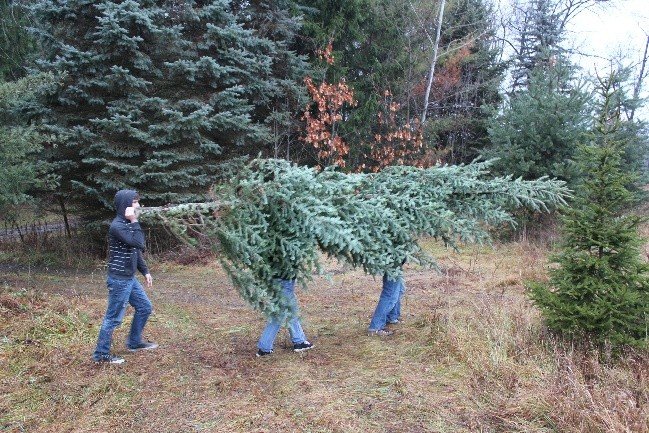
Many people who celebrate Christmas (or the holiday season in general) feel that their festivities won’t be complete without a Christmas tree to grace their living room.
Some folks are fans of fake trees for the mess-free experience, while others enjoy picking out a real tree to fill their home with that nostalgic pine scent. Which type of tree is better for the environment?
The short answer is that real trees are better for the environment! Real trees are grown locally in many parts of the United States, meaning that businesses don’t have to transport them as far to get them to your house. Additionally, many tree nurseries plant several seedlings for each tree ultimately sold to keep their stock in good shape, meaning there are additional trees in their nurseries that never get harvested and keep sequestering carbon. However, when looking for a real tree, it’s essential to ensure it is locally sourced and to ask the folks who grow the trees whether they use synthetic pesticides and herbicides to avoid harming the local environment. Another option for a truly waste-free tree experience is to buy a potted, living Christmas tree, which you can then plant outside in an appropriate spot after the holidays.
Artificial trees, in comparison, are often manufactured in China, and the emissions generated during international shipping are substantial. Additionally, fake trees are usually made from several materials, making them especially challenging to recycle. For more compelling reasons to go natural with your tree this season and how buying a local tree supports healthy forests, check out this article by the Nature Conservancy.³
As always, if you already have a plastic Christmas tree and it’s in good shape, don’t throw it away to buy a real tree! Keep using it for as long as possible. But if your artificial tree has seen better days and you’re looking to get rid of it, the Institute for Environmental Research and Education has some recommendations.⁴
How Compost a Real Tree
For those who never celebrate without a real Christmas tree, you are not alone! According to the United States Department of Agriculture’s Economic Research Service, U.S. tree farms cut more than 14.5 million Christmas trees in 2022, while the National Christmas Tree Association puts the number at 25-30 million trees annually.⁵ ⁶ That’s a ton of trees! However, many people throw their trees in the garbage after the holidays. Throwing fully compostable trees in the garbage contributes millions of pounds of organic matter to landfills, where it doesn’t decompose.⁷
Real Christmas trees are 100% recyclable through composting! Here’s a step-by-step guide to composting your tree in a garden or outdoor space:
- Take all ornaments and decorations, including lights and tinsel, off your tree.
- Using a handsaw or an axe, chop your tree into smaller pieces (approximately 6-inch sections).
- Pine needles are somewhat acidic and could throw off the pH balance of the compost pile, but they make a great mulch!⁸ Pull them off your tree sections and use them in other parts of the garden, or spread them around outside the compost pile to decompose and be neutralized.
- Compost piles need airflow to encourage decomposition – start your pile by spreading a layer of leaves, branches, and sections of your Christmas tree. These materials leave gaps that allow air to circulate into the pile, speeding up decomposition.
- You’ve not set up your pile! You can leave it to decompose on its own, or add more organic material, such as household veggie scraps, grass clippings, and plant cuttings. For more detailed info on starting a compost pile and optimizing your composting, check out this guide from Help Me Compost.⁹
Don’t have a yard or garden? Many municipalities have a Christmas tree recycling program or a yard waste drop-off station that accepts seasonal items. Search for services available in your municipality through your local trash and recycling collector or parks department. The National Christmas Tree Association has some other suggestions for creative ways to reuse your tree.¹⁰
Gifting Sustainably
Getting your loved ones the perfect gift can be challenging, especially since many people already have too much stuff. We’ve normalized overconsumption, and marketing around the holidays pushing us to push the latest smartphone, gaming system, or a whole new wardrobe, ultimately doesn’t fulfill our most profound need – our need to connect with those we care about. This holiday season, break out of that consumptive mindset and focus on what really matters: showing our loved ones we care with gifts that don’t hurt the planet.
A FEW EXAMPLES:
Give experiences over things. Sign up for a class together, plan the perfect outdoor activity, get tickets to a live event, or go somewhere new in your local area.

- Spending time together is a great way to create lasting memories. Services like ClassPass allow your loved ones to live up to that New Year’s Resolution to get in shape.¹¹ Support them on their journey by signing them up for the first month so they can find a gym they enjoy!
- Donate to a charity in a loved one’s honor. Make a positive impact on the world by donating to a charity that works on issues they care about. For maximum effect, donate to a local charity working in your community.
If you want to gift a physical item:
- Gift durable items over disposable ones – don’t follow fads! Get them something classic and timeless. Well-selected, quality items will mean far more than whatever item is trending. Some suggestions include a cast-iron pan, a cashmere sweater, or a pair of boots that a cobbler can resole when they get worn out. Bonus points for thrifting something! Thrift stores are full of perfect vintage items that make great gifts and will last a lifetime with appropriate care.
- Gift locally-sourced or homemade food items. Pick up a bottle of their favorite wine, support a local farm by purchasing a jar of honey or jam, or bake something at home.
- Make a gift. Suggestions include decorating a mug with paint markers, hand-crafting a thoughtful (fully recyclable!) card without glitter, knitting a pair of socks, decorating a picture frame, carving a dreidel or other meaningful wooden gift, and making a candle.¹² ¹³ ¹⁴
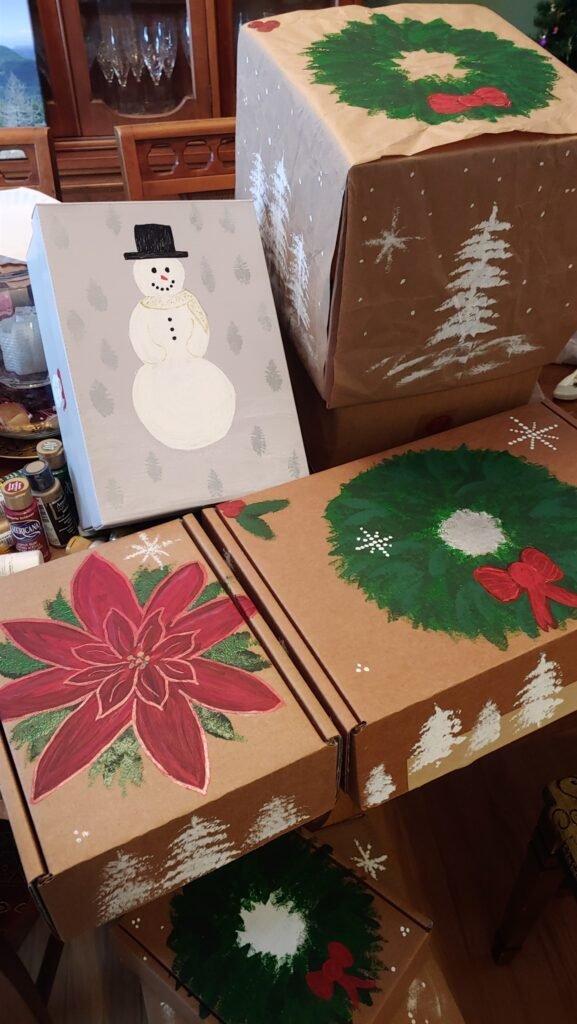
Don’t forget sustainable packaging! Save boxes from packages you received earlier in the year to reuse at the holidays. Wrap them in fully recyclable wrapping paper and skip plastic ribbons and bows.
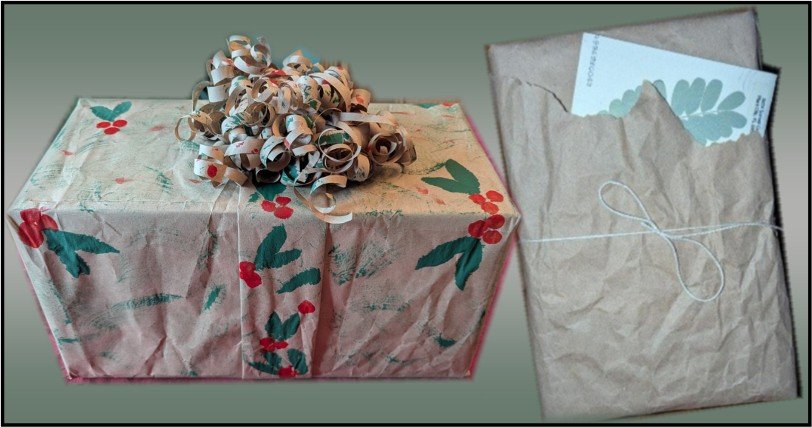
For wrapping, try newspaper or packing paper, and paint the package using non-toxic paint if desired. Linen sacks and handkerchiefs also make great, fully reusable wrapping options!
Eco-Friendly Holiday Decorations
Ditch the plastic tinsel and garlands this year in favor of fully biodegradable, easy-to-make, and easy-to-hang decorations! These are all old holiday favorites that have become more popular in recent years as folks look for ways to keep the holidays green.
Try making some of the following items for your home, and be sure to compost all organic matter once the holiday season is over to keep things truly zero-waste!

- Popcorn strings. One of the simplest holiday decorations: all you’ll need are popcorn kernels (you can pop them yourself or buy pre-popped from the store), a 100% cotton thread, and a needle with a large eye. Thread the needle with your cotton thread and then push the needle through the pieces of popcorn one at a time. Hang indoors on a tree, over doorways, or wherever you like! You can also add cranberries or dried oranges (see #3 below) for an extra pop of color.
- Paper snowflakes. A classic that brings back memories of making these in elementary school. The only materials required are paper (printer paper, construction paper, or even old newspapers) and a pair of scissors. To make sophisticated paper snowflakes, check out this tutorial by Wonder Crafts.¹⁵
- Dried oranges. These will add beautiful color to your home and smell delicious! You can dry the orange slices with either a dehydrator or an oven. See this recipe and guide from The Ginger Home for more details on drying your orange slices, and you can swap out fishing line for 100% cotton thread for a fully biodegradable decoration.¹⁶
- Pine boughs. Pick up some wherever you can get a Christmas tree! Tie them together with cotton thread and hang above doorways or on a mantle.
- DIY Gingerbread house. Get the whole family involved, or invite some friends over and make it a group project! For a full recipe, see Simply Recipes’ guide here.¹⁷
Actions to Take in Your Life
At Wading In, we’re all about meeting you where you are and providing actionable solutions that fit into your life. Check out our recommendations below for amplifying your individual actions; choose the ones that work for you and start today!
🌱Earth Friend – Easy adjustments that require minor changes.
- Skip the single-use packaging and choose recyclable or reusable gift wrapping. (Newspaper, fabric, canvas bags.) Also, skip the plastic ribbon and bow.
- Sustainable Tree, choose a locally grown sustainable Christmas tree, or, if you use an artificial one, try to keep it for years to reduce its footprint.
🌿 Green Defender – More intensive swaps and adjustments that require greater effort.
- Compost your Christmas tree, through your local municipality drop-off or a tree-cycling program. This is an easy way to keep organic matter out of landfills.
- Make DIY holiday decor, (popcorn strings, dried oranges, pine boughs, etc. ) instead of buying plastic or single-use decorations.
- Gift experiences, handmade gifts, thrifted goods– to reduce the environmental waste and support more meaningful, low-impact giving.
🌍 Environmental Warrior – Lifestyle changes with a bigger impact.
- Start a home compost pile (or join a community compost program) with your Christmas tree! This focuses on giving back to the earth.
- Low-waste holiday tradition, focus more on experience giving and handmade gifts.
- Commit to buying local, durable goods year-round, not just at the holidays. It is great to reduce our carbon footprints and support our local communities.
- Adopt a “Buy Nothing December” (or week!), where you focus on experiences, connection, and creativity instead of purchasing new items.
- Host a low-waste holiday gathering by using real dishes, cooking with locally sourced ingredients, and planning meals to minimize food waste.
| Individuals have power and can make a difference to positively change the world. Every day presents new opportunities to learn and grow. Not everything is within our control – but we can control our own actions and can inspire others to make positive change. Until next time,  |
References
¹ The Environmental Protection Agency. (n.d.). Green your holiday scene. https://archive.epa.gov/students/web/html/holiday.html.
² Evreka. (n.d.). Coping with Christmas waste. https://evreka.co/blog/coping-with-christmas-waste/.
³ The Nature Conservancy. (n.d.). Real vs. fake—Which Christmas tree is better for the environment? https://www.nature.org/en-us/what-we-do/our-priorities/protect-water-and-land/land-and-water-stories/real-vs-fake-christmas-tree/#:~:text=Out%20of%20the%20350%2D500,wildlife%20depends%20on%20to%20survive.
⁴ IERE Team. (2025, June 27). Where to recycle artificial Christmas tree? Institute for Environmental Research and Education. https://iere.org/where-to-recycle-artificial-christmas-tree/.
⁵ Scott, S. (2024, December 4). 2022 Census of Agriculture: U.S. tree farms cut more than 14.5 million Christmas trees in 2022. U.S. Department of Agriculture Economic Research Service. https://www.ers.usda.gov/data-products/charts-of-note/chart-detail?chartId=110530.
⁶ National Christmas Tree Association. (n.d.). Quick tree facts. https://realchristmastrees.org/Education/Quick-Tree-Facts/.
⁷ High Country Conservation Center. (n.d.). Ask Eartha: Why we don’t want our trash to ‘break down’ in the landfill? https://highcountryconservation.org/ask-eartha-why-we-dont-want-our-trash-to-break-down-in-the-landfill/.
⁸ University of New Hampshire. (2019, October 16). Do pine trees and pine needles make soil more acidic? https://extension.unh.edu/blog/2019/10/do-pine-trees-pine-needles-make-soil-more-acidic.
⁹ Roebuck, A. (n.d.). Brown-to-green compost ratio (the easiest guide ever!). Help Me Compost. https://helpmecompost.com/compost/basics/brown-to-green-compost-ratio/.
¹⁰ National Christmas Tree Association. (n.d.). How to recycle. https://realchristmastrees.org/All-About-Trees/How-to-Recycle/.
¹¹ ClassPass. (n.d.). Home page. https://classpass.com/.
¹² Griffiths, M. (2024, July 16). Painted Sharpie mugs (that won’t wash off!). Bless this Mess. https://www.blessthismessplease.com/painted-sharpie-mugs-that-wont-wash-off/.
¹³ Gray, B. (2022, November 5). 7 wood carving tools for beginner woodworkers (accessible). The Tool Square. https://thetoolsquare.com/wood-carving-tools-beginner/.
¹⁴ Fisher, D. (2024, July 17). A beginner guide to candle making. The Spruce Crafts. https://www.thesprucecrafts.com/basic-candle-making-instructions-516753.
¹⁵ Wonder Crafts. (2025, November 9). Easy paper snowflake tutorial – How to make snowflakes out of paper – Christmas decorations. YouTube. https://www.youtube.com/watch?v=do9EOcxqxwU.
¹⁶ The Ginger Home. (2019, November 9). How to make a dried orange garland. https://thegingerhome.com/how-to-make-a-dried-orange-garland/.
¹⁷ Bauer, E. (2025, October 27). How to make a gingerbread house. Simply Recipes. https://www.simplyrecipes.com/recipes/how_to_make_a_gingerbread_house/.